Generative Engine Optimization (GEO): How to Get Cited in AI Answers
 Ansar Bhatti
9 min read

A growing share of people now ask a question to ChatGPT, Gemini, Perplexity or an AI summary in a search engine and read the answer without ever visiting a website. If your business is not part of that answer, you are invisible at the moment someone forms a shortlist. Generative engine optimization, usually shortened to GEO, is the practice of making your brand and content easy for AI systems to find, understand and cite. This guide explains what we know, what we do not, and what is worth doing now.
What GEO actually is
Traditional SEO aims to rank a page in a list of links. GEO aims to be included, accurately and favorably, inside a generated answer. The two overlap heavily, because many AI tools retrieve web pages in real time and then summarize them. A page that is easy to crawl, clearly written and trusted by other sites is more likely to be used by both a search engine and an answer engine.
It helps to be honest about the limits. There is no official ranking factor list for AI assistants, models change often, and results can differ between prompts and over time. Anyone who promises guaranteed placement inside AI answers is overstating what is possible. What you can do is improve the odds with sound fundamentals and a few targeted additions.
How AI answers are assembled
There are two broad sources behind an answer. The first is what a model learned during training, which reflects the web as it was up to a certain point. The second is retrieval, where the tool searches the live web or an index, pulls a handful of pages and uses them to write the response. Many modern assistants and AI search features rely heavily on retrieval for factual and recent questions.
That distinction matters. You cannot easily change what a model already learned, but you can influence retrieval, because retrieval works with pages that are crawlable, clear and relevant to the question being asked.
Make your content easy to quote
AI systems favor passages that answer a question cleanly. Write with that in mind without turning your pages into robotic lists.
- Lead with the answer. Put a direct, self-contained answer in the first sentence or two beneath a heading, then expand with detail.
- Use question-style headings that mirror how people actually ask, such as how much something costs or how long a process takes.
- Define terms plainly. A clear definition of a concept is easy to lift and reuse.
- Add specifics. Numbers, steps, named methods and real examples are more useful than vague claims, as long as they are accurate and sourced when needed.
- Show who wrote it. Named authors with relevant experience and a clear editorial standard make a page more credible to people and to systems that evaluate trust.
We go deeper on page formats and answer structure in our guide to answer engine optimization.
Strengthen your entity and brand signals
AI systems reason about entities, meaning identifiable things such as a company, a person or a product, and the relationships between them. If your brand is described inconsistently or barely mentioned elsewhere, a model has little to work with.
- Use the same business name, description and contact details everywhere.
- Publish a clear About page that says who you are, what you do, where you operate and who runs the business.
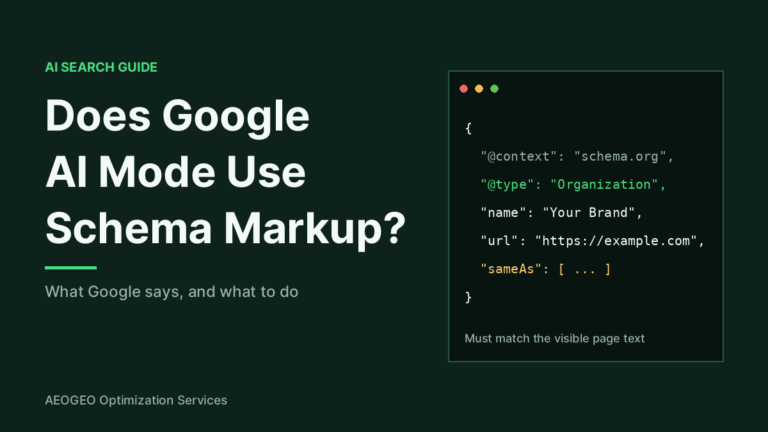
- Link your official profiles from your site, and mark them up with Organization schema using the sameAs property.
- Earn mentions on reputable third-party sites, such as industry publications, directories and partner pages. Independent mentions are strong evidence that a business is real and notable.
- Keep reviews and profile information current on the platforms where customers look.
Structured data is part of this effort. Our JSON-LD schema guide shows how to describe your organization, people and content in a form machines can read without guessing.
Check that AI crawlers can reach you
If your server or security layer blocks AI crawlers, those systems cannot read your pages. Review your robots.txt file and your firewall or CDN settings. Several providers publish named crawlers, including OpenAI’s GPTBot and OAI-SearchBot, Anthropic’s ClaudeBot and Perplexity’s PerplexityBot, and Google offers a Google-Extended control related to its AI products. Decide deliberately which you want to allow. Some publishers block training crawlers while still permitting search-related ones, and the right choice depends on your business goals.
You may also come across llms.txt, a proposed file that offers a plain-language map of a site for language models. It is an emerging convention rather than an established standard, and major providers have not confirmed that they rely on it. It is cheap to add and unlikely to cause harm, but it should not be treated as a ranking lever. Rank Math can generate one if you want to experiment.
Cover topics in depth
AI systems often assemble answers from several sources, and they tend to favor sites that clearly own a subject. Building out connected content around your core services, rather than isolated posts, makes it easier for a system to recognize you as a reliable source. The planning method is the same one used for traditional SEO, covered in our article on keyword research and topic clusters.
Original information gives you something to be cited for
Generic content that repeats what every other site says offers no reason to be chosen. Publish things others cannot easily copy: your own data, case studies with real results, clear methodologies, expert commentary and practical templates. When a claim originates with you and is well documented, other sites and AI tools have a reason to reference it.
How to measure GEO progress
Measurement is imperfect, so combine a few approaches.
- Test prompts by hand. Build a list of the questions your customers ask and run them regularly in several assistants. Record whether your brand is mentioned, whether it is described accurately, and which sources are cited.
- Watch referral traffic. In your analytics, look for visits from AI assistant domains. Volumes are often small today, but they are growing and tend to be well qualified.
- Use a monitoring tool. Some SEO plugins and platforms now track brand mentions across AI platforms. Treat the numbers as directional rather than precise.
- Track branded search. If more people search for your name after being introduced through an AI answer, branded query growth in Search Console is a useful signal.
Mistakes to avoid
- Dropping SEO fundamentals in favor of tricks. Retrieval still depends on crawlable, relevant, trusted pages. Our technical SEO checklist remains the foundation.
- Mass-producing AI-written pages with no original insight. They add noise and do little for trust.
- Stuffing pages with hidden prompts or instructions aimed at models. This is manipulative and can be penalized.
- Assuming one test prompt tells the whole story. Answers vary, so sample widely.
A simple GEO audit you can run this week
You do not need special software to learn where you stand. This manual audit takes an afternoon.
- Write ten real customer questions. Include a few that name your category, such as who offers a service in your area, and a few that compare options or ask about cost.
- Run each in several assistants. Try at least two or three tools, and use a fresh conversation for each question so earlier context does not bias the result.
- Record the results in a table. Note whether your brand appears, how it is described, which competitors are named and which sources are cited.
- Check accuracy. Look for wrong addresses, outdated services or invented details. Errors usually trace back to inconsistent or missing information on the web.
- Trace the sources. Where an assistant cites pages, read them. You will often find the same few directories, publications or competitor articles repeated. Those are the places to earn a mention.
- Repeat monthly. Compare results over time rather than reacting to a single run.
What citable content looks like
Content is more likely to be quoted when it contains something a generic page lacks. Examples that work across industries include:
- A clear methodology, such as the exact steps of how you audit, install or deliver something.
- Original data from your own work, such as anonymised results or survey findings, with the method described honestly.
- Plain-language definitions of terms your customers struggle with.
- Honest comparisons that explain when an option is a good fit and when it is not.
- Practical templates, checklists and calculators that others link to.
Avoid inventing statistics or claiming results you cannot support. Accuracy protects your credibility with both readers and the systems that evaluate sources.
To compare GEO with its sibling discipline and understand the budget, read AEO vs GEO optimization services compared, AI-driven visibility services in GEO and AEO and a comparison of GEO and AEO service costs.
Frequently asked questions
Is GEO different from SEO?
They overlap heavily. SEO aims to rank pages in results lists, while GEO aims to make your brand present and accurately described in generated answers. Most of the work, such as clear content, technical health and trusted mentions, helps both.
Can I guarantee my business appears in ChatGPT or Gemini?
No. Nobody can, because these systems are not controlled by site owners and they change often. You can improve your chances with sound content, clear entity signals and good technical access.
Should I block AI crawlers?
It depends on your goals. If you want to be visible in AI search results, blocking the relevant crawlers works against you. Some publishers block training crawlers but allow search-related ones. Make the choice deliberately and review it periodically.
Does llms.txt help?
It is an emerging idea, and major providers have not confirmed that they use it. It is low cost and low risk, but it should not replace the fundamentals.
Related: GEO services, how to get mentioned in ChatGPT, how to track brand visibility in AI search.
Also read: getting cited by Perplexity.
Also read: AI visibility audit, ranking in Microsoft Copilot.
Working with a dental practice? See our page on GEO for dentists.
Where this fits in your wider plan
GEO works best as an extension of a sound search strategy, not a replacement for it. If you are still defining that foundation, start with our guide to building an SEO strategy for a small business. To see how we help brands become visible in both search results and AI answers, visit our services page, or contact us for an assessment of where your brand appears today. For a full overview of what a specialist provider covers, read our guide to AEO, GEO and AI search optimisation services.