AEO GEO AI Search Optimisation Services: What a Specialist Company Delivers
 Ansar Bhatti
11 min read

Search is no longer a single list of ten blue links. People now ask questions to ChatGPT, Gemini and Perplexity, read AI-written summaries at the top of Google, and use voice assistants to find a nearby business. A company that offers AEO, GEO and AI search optimisation services helps your brand show up accurately in all of those places, not only in the traditional rankings. This guide explains what such a company should actually do, how the work is organised, how it differs from a conventional SEO agency and how to judge whether a provider is worth hiring.
What AEO, GEO and AI search optimisation mean
The three terms are closely related, and providers sometimes use them loosely, so it helps to define them.
- AEO (answer engine optimisation) is structuring pages so that search features and assistants can lift a direct, correct answer from them. It covers featured snippets, People Also Ask boxes and voice answers. We explain the page-level methods in our answer engine optimization guide.
- GEO (generative engine optimisation) is increasing the chance that your brand is mentioned and cited inside AI-generated responses. It leans on entity clarity, trusted third-party mentions and content worth quoting. Our GEO guide covers what is known and what remains uncertain.
- AI search optimisation is the umbrella phrase. It means preparing a website and brand for every system that answers questions with generated text, while still performing well in classic search.
None of this replaces SEO. It builds on it. Pages that cannot be crawled, load slowly or say nothing original will struggle in AI answers for the same reasons they struggle in rankings.
Why businesses are paying attention now
Two shifts are driving demand. First, a growing share of research happens inside assistants and AI summaries, where users may read an answer and never click through. Second, those answers often name a small number of businesses or sources, so being included or left out matters more than a position on a long results page.
It is worth being honest about the uncertainty. Referral traffic from AI assistants is still a small share of most sites’ visits, the systems change frequently and measurement is imperfect. The case for acting is not that AI search has replaced everything. It is that the preparation is mostly good practice that also helps traditional search, so the downside of starting early is low.
The service stack: what a good company covers
1. A sound technical foundation
Every other layer depends on this. The company should audit crawling, indexing, site structure, redirects, mobile usability and speed, and fix what it finds. It should also check that AI crawlers are not blocked by accident through robots.txt, a firewall or a CDN rule. Our technical SEO checklist for WordPress shows what this audit looks like, and our guide to Core Web Vitals and WordPress speed covers the performance part.
2. Content built around questions and topics
The provider should research the questions your customers actually ask, group them into topic clusters and map each cluster to one page. New content should lead with direct answers, use clear headings, lists and tables where they fit, and add original information such as data, examples and process detail. The planning method is described in our guide to keyword research and topic clusters.
3. Structured data and entity clarity
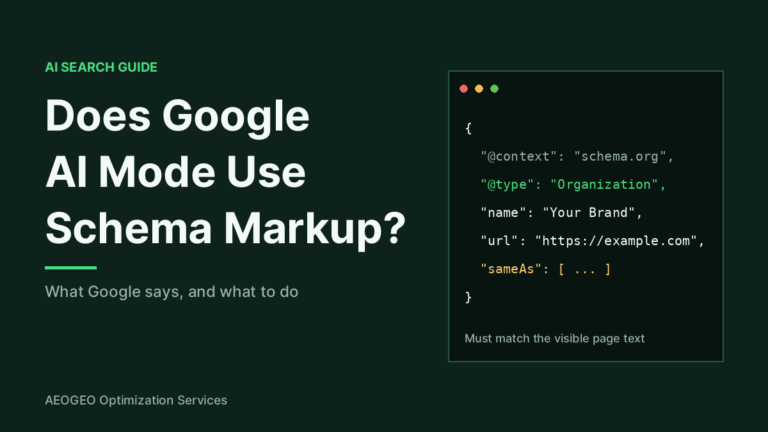
Machines need an unambiguous description of who you are. That means Organization, LocalBusiness, Article, Person and breadcrumb markup that matches visible content, consistent naming across the web, a complete About page and official profiles linked with the sameAs property. See our JSON-LD schema markup guide for the types worth implementing.
4. Authority and third-party mentions
AI systems and search engines both look for independent evidence that a business is real and respected. A good company helps you earn that through relevant directories, partner pages, local organisations, press where there is genuine news, and useful resources others choose to cite. It does not buy links or run schemes.
5. The local layer, where it applies
If you serve a geographic area, your Google Business Profile, consistent business details and reviews influence both map results and the way assistants answer location-based questions. Our local SEO guide lists the steps in detail.
6. Implementation on your actual website
Strategy that never reaches the site is wasted. The provider should be able to make the changes themselves or give developers precise instructions: templates, heading structure, schema output, internal links, speed fixes and clean markup. For WordPress sites this overlaps with development quality, covered in our article on WordPress development best practices, and with the choice of front-end approach, compared in custom theme versus page builder.
7. Measurement you can understand
Reporting should combine traditional metrics with AI-specific checks. That includes impressions, clicks and positions from Search Console, leads from forms and calls, a documented set of customer questions tested across several assistants on a regular schedule, referral visits from assistant domains and growth in branded search. It should state clearly which numbers are estimates.
How an engagement is usually organised
| Phase | What happens | What you receive |
|---|---|---|
| Audit | Technical review, content review, entity and schema check, baseline AI answer testing | A prioritised findings report |
| Plan | Question and topic research, content map, priority fixes | A roadmap tied to your goals |
| Build | Technical fixes, schema, template and page improvements | Changes live on your site |
| Publish | New answer-led content, updates to existing pages, internal linking | Content published and connected |
| Monitor | Monthly reviews of search data, AI answers and leads | A clear report and next actions |
Larger or more complex sites need more time in the audit and build phases. A small local business can move through them faster.
How this differs from a traditional SEO agency
| Area | Traditional SEO focus | AEO, GEO and AI search focus |
|---|---|---|
| Goal | Rank pages in a results list | Rank, and also be quoted and named in answers |
| Content style | Keyword-targeted pages | Question-led pages with direct answers and original detail |
| Technical work | Crawl, index, speed | The same, plus AI crawler access and clean structured data |
| Authority | Backlinks | Backlinks plus consistent entity signals and independent mentions |
| Reporting | Rankings and traffic | Rankings, traffic, AI mentions and branded search |
In practice the best providers do both under one plan. If you are still shaping the overall approach, start with our guide to building an SEO strategy for a small business.
How to choose a provider
Ask these questions before you sign anything.
- What exactly will you change on my site, and how will you show me? Look for specific, checkable deliverables.
- How do you measure AI visibility, and what are the limits of that measurement? A candid answer is a good sign.
- Who writes and reviews the content? Expect subject knowledge, editing and fact checking, not unreviewed machine output.
- How do you earn links and mentions? Be wary of vague answers.
- What happens to the work if we stop? You should own the content, the access and the documentation.
- Can I speak to or see work for a similar business? Relevant examples matter more than logos.
Red flags
- A promise of guaranteed placement in ChatGPT, Gemini or Google results. No provider controls these systems.
- Tactics that hide instructions for models inside pages, or any other manipulation. These can be penalised and damage trust.
- Mass-produced AI articles with no original insight or review.
- Reporting that shows only activity, such as tasks completed, with no link to leads or visibility.
- Long lock-in contracts with no clear deliverables.
- Dismissing technical SEO and site speed as unimportant.
What affects cost and timing
Pricing depends on the size of the site, the number of services and locations, the state of the technical foundation, how much content must be created or rewritten, and how competitive your market is. A brand-new site with serious technical problems needs more groundwork than a healthy site that only needs better answer structure. Beware of any provider who quotes before looking at your site.
On timing, technical fixes and structured data can be live within weeks, and search engines may take time to reflect them. Content and authority work compounds over months. Treat any specific timeline as an estimate rather than a promise, because results depend on competition, your starting point and consistency of effort.
Who benefits most
- Service businesses and local firms whose customers ask assistants for recommendations near them.
- B2B companies and consultancies whose buyers research options through long, specific questions.
- Publishers and educators whose expertise can be cited as a source.
- Online stores where product comparisons increasingly happen inside AI summaries.
How we approach it
At AEO GEO Optimization Services we combine SEO, technical SEO, answer engine and generative engine optimisation, and WordPress development in one service, so the strategy and the changes to your site come from the same team. That includes custom WordPress themes and Elementor-editable pages built with clean markup, structured data and speed in mind. You can read more about us and our founder, browse the full list of services or compare the pricing plans to see what a monthly engagement includes.
A realistic 90-day roadmap
Every business is different, but a first quarter often follows a pattern like this one. Treat it as a planning aid, not a guarantee.
Days 1 to 30: baseline and foundation
- Connect and review Search Console and analytics, and set up conversion tracking.
- Run the technical audit and fix critical issues such as crawl blocks, duplicate URLs and broken redirects.
- Check that AI crawlers are not blocked by mistake.
- Record a baseline by testing your customers’ questions across several assistants.
- Review your brand details across the web and list inconsistencies.
Days 31 to 60: structure and content
- Implement or correct Organization, LocalBusiness, Article and breadcrumb markup.
- Build the question and topic map and choose the first cluster to develop.
- Rewrite your most valuable service pages with direct answers, clear headings and stronger internal links.
- Improve speed on the templates that matter most.
Days 61 to 90: authority and expansion
- Publish supporting articles for the first cluster and link them to the pillar page.
- Start steady review requests and update business profiles.
- Pursue a small number of relevant third-party mentions.
- Re-test the same customer questions and compare against the baseline.
- Plan the next quarter based on what the data shows.
To go deeper on choosing and pricing these services, read AEO vs GEO optimization services compared, the types of agencies offering SEO, AEO and GEO services, how to choose the best agency for AI visibility services, a comparison of GEO and AEO service costs, choosing AEO and GEO services in the USA and AI-driven visibility services in GEO and AEO.
Frequently asked questions
What is the difference between AEO and GEO?
AEO focuses on structuring content so assistants and search features can extract a direct answer. GEO focuses on brand presence and citation inside generated responses. In practice they share most tactics.
Do I still need traditional SEO?
Yes. AI systems frequently retrieve and summarise pages from the open web, so crawlable, relevant, trusted pages remain the foundation. Traditional search also still delivers most organic traffic for many businesses.
Can a company guarantee results in AI search?
No honest provider can. The systems are controlled by their owners and change often. A good company can show what it will change, how it measures progress and why those changes improve your chances.
Is this suitable for a small local business?
Yes. For local firms the work often centers on a strong Business Profile, accurate details, clear service and location pages, reviews and structured data, which suits both map results and assistant recommendations. Our local SEO guide explains the details.
How do I know if the work is succeeding?
Look for growth in impressions and clicks for question-style queries, more accurate and frequent mentions in your test prompts, rising branded search and, above all, more enquiries from the pages you improved.
What is an AEO GEO AI search optimisation services company?
It is a company that helps your business appear accurately in answer features and AI-generated responses, in addition to traditional search results. A good one covers technical SEO, answer-first content, structured data, brand consistency and repeat AI visibility testing, and is honest that results cannot be guaranteed. Our guide to choosing the best agency for AI visibility services shows how to compare companies.
How much do AEO GEO AI search optimisation services cost?
The price depends on site size, competition and the number of locations. Page-level AEO work is usually priced per page or as a project, while GEO work is usually a monthly plan. See our cost comparison for details.
Explore our service pages: AEO services, GEO services, AI SEO services.
Also read: AI search optimization for small business.
Also read: AI visibility audit, schema markup services.
Where to start
The simplest first step is a baseline. Check how your site performs in Search Console, ask a few assistants the questions your customers ask and note who is mentioned. Then fix the technical basics, make your brand unambiguous and improve your most valuable pages with direct answers. If you would like us to run that baseline for you, contact us and we will tell you honestly where you stand and what is worth doing first.