How to Get Your Brand Mentioned in ChatGPT and Other AI Assistants
 Ansar Bhatti
8 min read

More buyers now ask ChatGPT who to hire, what to buy and which tool to try, instead of scrolling through ten blue links. If your brand is named in that answer, you get a warm lead. If it is not, a competitor does. This guide explains how to get your brand mentioned in ChatGPT and other AI assistants, what is within your control, and what no honest provider can promise. It is practical and based on how these systems are documented to work, not on rumors or hacks.
One caution first. Nobody outside OpenAI knows the exact formula that decides which brands appear in an answer, and it changes. What follows is the set of steps that reliably improve your chances, because they make your business easier to find, easier to understand and easier to trust.
How ChatGPT decides which brands to mention
ChatGPT builds answers from two broad sources. The first is what the model learned during training, which is a snapshot of text from the public web and licensed data. The second is live information, which it can fetch through search when a question needs current facts. Brand mentions come from both.
- Training memory. If your brand was described consistently and often across reputable sources before the model was trained, the model is more likely to “know” it. You cannot edit this directly. You can only build a stronger footprint for the next time.
- Live search and retrieval. When ChatGPT searches, it reads pages and picks sources it can quote or cite. Here your current pages, your technical health and your rankings in the underlying search indexes matter. OpenAI does not publish every provider it uses, so treat any claim about a single secret source with suspicion.
This is the core idea behind generative engine optimization: improve the signals that both memory and retrieval rely on. Our GEO guide covers the full approach.
Step 1: Check what AI assistants say about you today
Before you change anything, record a baseline. Open ChatGPT and, ideally, a couple of other assistants, and ask questions a real customer would ask. Write down the exact prompt, the date, whether your brand was mentioned, and which competitors were.
- “What is [your brand]?” to see whether it knows you exist and describes you correctly.
- “Best [your service] for [your type of customer] in [your location]” to see who gets recommended.
- “[Your brand] vs [competitor]” to see how you are compared.
- “Is [your brand] good for [use case]?” to see what claims are repeated.
Answers vary between runs, so ask each question a few times and look at patterns, not single results. Wrong facts in these answers (old prices, wrong services, a different location) tell you which pages and profiles to fix first.
Step 2: Let the right crawlers in
If crawlers cannot read your site, the live-search side of the equation is closed to you. OpenAI documents separate user agents with different jobs:
| Crawler | Purpose | What blocking it does |
|---|---|---|
| OAI-SearchBot | Finds pages for ChatGPT search results | Your pages are less likely to appear as search sources |
| ChatGPT-User | Fetches a page when a user asks ChatGPT to open it | Users cannot have it read your page on request |
| GPTBot | Collects content that may be used to train models | Your content is excluded from future training; some sites choose this on purpose |
Whether to allow GPTBot is a business decision. If you want maximum visibility, allow all three. If you want to stay out of training data but still appear in search, you can block GPTBot and allow the other two. Review your robots.txt file and any security plugin or CDN rule that blocks bots by default. A surprising number of sites block AI crawlers by accident.
Also make sure important content is in the HTML, not hidden behind scripts or login walls, and that pages load quickly. Our technical SEO checklist covers these basics.
Step 3: Make your brand facts clear and consistent
AI systems work with entities: a business name, what it does, where it is and who runs it. If those facts differ across your website, social profiles and directories, the model gets mixed signals and may skip you or get details wrong.
- Use the same business name, description, address and phone number everywhere.
- Write a plain “About” page that states who you are, what you offer, who you serve and where, in simple sentences.
- Keep one short brand description and reuse it on your site, LinkedIn, Google Business Profile and directory listings.
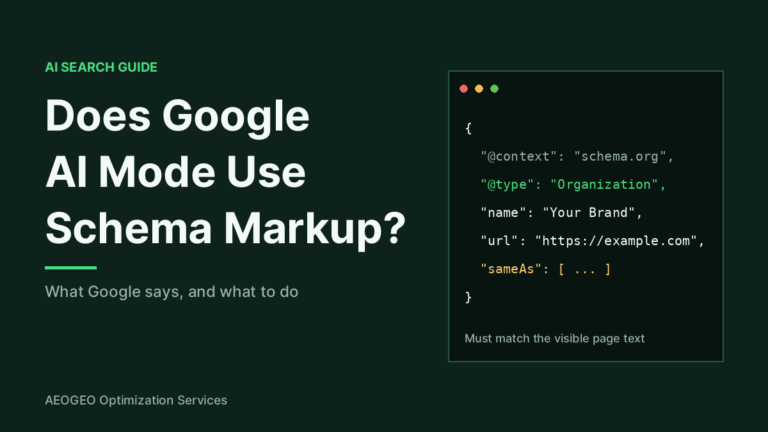
- Add Organization schema with your name, logo, website and profile links, so machines can connect the dots. See our schema markup guide.
Step 4: Write content that answers the question first
Assistants prefer to quote pages that give a direct, self-contained answer. Put the answer in the first sentence or two under each heading, then add the detail. Use question-style headings that match how people ask, and keep paragraphs short.
Useful formats include definitions, step-by-step guides, comparison tables, pricing explanations and FAQ sections. Include real specifics such as your process, your ranges and your limits. Vague marketing copy gives a model nothing to quote. This is the heart of answer engine optimization, and our AEO guide shows the page patterns in detail.
Step 5: Earn mentions on trusted third-party sources
Models and search tools lean on what independent sources say about you, not only what you say about yourself. Brands that are discussed in several credible places are easier to recognize and safer to recommend.
- Get listed in relevant industry directories and review platforms, and keep those profiles complete.
- Contribute expert articles, interviews or quotes to publications your audience reads.
- Publish original data, case studies or tools that others want to reference.
- Encourage genuine customer reviews on platforms that matter in your market.
- Take part in real community discussions where your customers ask for advice, and be helpful, not promotional.
This is slow work, and it is also the part competitors cannot copy quickly. Quality beats quantity: ten credible mentions are worth more than a hundred junk listings.
Step 6: Keep ranking in traditional search
AI answers and classic search overlap more than people think. Pages that are indexed, fast and well linked are easier for any retrieval system to find. Do not abandon SEO to chase AI visibility. The strongest approach is one plan that covers both, which is what our AI SEO services are built around.
Step 7: Measure, then repeat
Re-run your baseline prompts every month and log the results in a simple sheet: prompt, assistant, mentioned or not, accuracy, competitors named and cited sources. Watch your analytics for visits from AI platforms, which often show up as referral traffic. Look for trends over a few months instead of reacting to a single answer.
What does not work
- Guaranteed placement. Anyone selling a guaranteed ChatGPT mention is guessing or misleading you.
- Hidden text aimed at AI. Invisible prompts or keyword stuffing can get you penalized by search engines and are not a legitimate tactic.
- Mass-produced AI content. Thin pages add noise and rarely get cited.
- Fake reviews and bought mentions. They damage trust and are risky if discovered.
Frequently asked questions
Can I pay to be mentioned in ChatGPT?
Not in the organic answers. Be careful of anyone who claims they can buy a placement. You can improve your chances through the steps above, but the results are never guaranteed.
How long does it take to appear in ChatGPT answers?
Live-search improvements can show up within weeks once pages are recrawled. Changes to what the model “knows” depend on future training updates, so expect months.
Do I need a large brand to be mentioned?
No. Smaller businesses can be recommended, especially for specific local or niche questions, when their information is clear, consistent and supported by independent sources.
Should I block GPTBot?
That depends on your goals. Blocking GPTBot keeps your content out of training data but does not by itself stop ChatGPT search from reading your pages through its other crawler. Decide based on how you want your content used.
Is this different from SEO?
It builds on SEO. The foundations are the same, and you add clear entity facts, answer-first content and third-party credibility.
Also read: allowing or blocking AI crawlers, getting cited by Perplexity.
Also read: ranking in Microsoft Copilot, optimizing for Claude.
Also read: how to get cited in Google Gemini.
Want help being found by AI assistants?
If you want a clear picture of what ChatGPT says about your business today and a plan to improve it, contact us with your website address. We will review your visibility and tell you what is worth fixing first. You can also see how our AEO and GEO services work.